
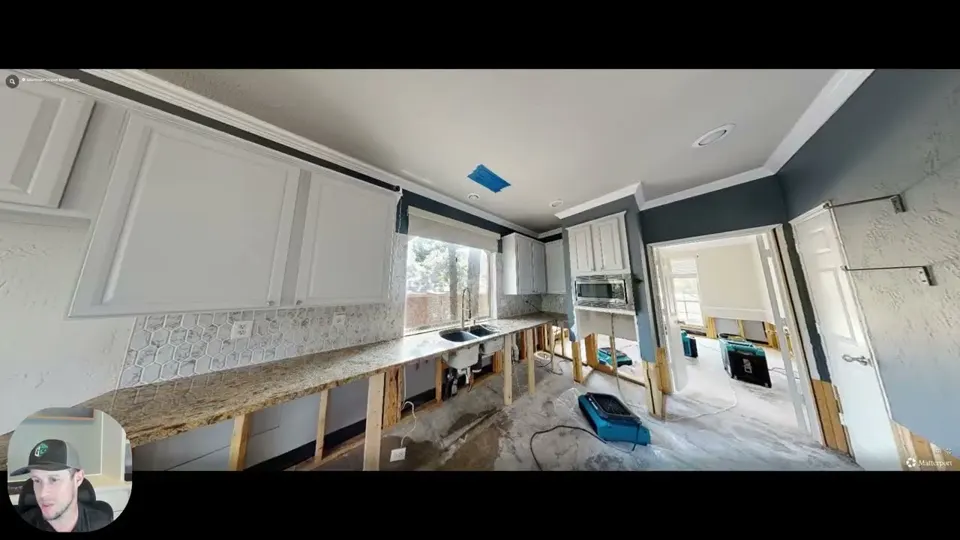
 WatchUnderstanding Water Loss Claims: A Homeowner's Case Study
Drywall is one of the first things people see after a leak. A stain on the ceiling, a bubble in the paint, a wall that feels soft at the bottom. The question that follows is almost always the same: "Do we have to cut it out?"
The answer depends on what kind of water it was, how long it sat and what's inside the wall. Here's how our mitigation partner, CMDR Restoration (licensed by TDLR, RCO #1801), thinks it through.
Why Is Drywall So Vulnerable to Water?
Drywall is a gypsum core sandwiched between paper. Gypsum soaks up water like a sponge, and when it gets saturated it loses strength. The paper facing is organic, which means it's food for mold. Behind it, you often have insulation with a paper backing and wood studs, which are also organic. Add moisture and warmth and you have the three things mold needs to grow.
When Can Wet Drywall Be Dried in Place?
Drywall can sometimes be saved when:
- The water was clean, like a supply line, not a sewer backup or floodwater
- It was caught quickly and hasn't been wet for long
- The board hasn't swollen, crumbled or sagged
- There's no insulation behind it holding water against the back
- Moisture readings show the drywall is responding to drying
In those cases, CMDR may dry the wall in place with air movers and dehumidifiers, sometimes drilling small holes near the bottom to move air inside the cavity. Moisture readings decide whether it worked.
When Does Drywall Need to Come Out?
Removal is usually the call when:
- The water was gray or contaminated (Category 2 or 3)
- The drywall is swollen, soft or crumbling
- There's insulation behind it that's soaked
- The ceiling drywall is sagging, which is also a safety issue
- Mold is visible or the area has been wet for a long time
What Is a Flood Cut, and Why 2 Feet?
A flood cut is a straight, level cut along the wall above the wet line so the lower section can be removed. Matthew explains this one in our videos all the time. IICRC standards call for removing materials mold can grow on at least 18 inches above where moisture was found. Most crews just go to 2 feet. A sheet of drywall is 4 feet tall, so cutting it in half makes the replacement fast and clean.
If moisture readings show water wicked higher than that, the cut goes higher. It's driven by what the meter says, not by habit.
What Happens When Too Little Gets Removed?
This is where homeowners get hurt. We've seen water losses where only a small patch of drywall came out, carpet stayed down and nobody checked how far the water traveled. The homeowner started putting things back, and later the musty smell showed up. At that point, new work has to be torn out to fix old work.
On larger losses, we like having a written protocol from a licensed indoor environmental professional. That's an unbiased third party who maps what must come out and how it should be cleaned, then tests afterward and issues clearance. It takes guesswork off the table for everybody.
What Should I Do Right Now If My Drywall Is Wet?
- Stop the water source and shut off power to the area if outlets are wet and you can do it safely.
- Take photos and video of the walls, ceiling and floor before anything is moved.
- Don't poke holes in a sagging ceiling yourself. Keep people out from under it.
- Pull baseboards only if you're comfortable. Otherwise leave it for the crew.
- Call for a moisture assessment. Our guide on how structural drying works explains what's next.
What Does the Rebuild Look Like?
Once the wall cavity is dry and clean, G3 hangs new drywall, tapes, floats, textures and paints to match. Because flood cuts are level, the repair is usually straightforward. Texture matching is part craftsmanship and part patience, and we take both seriously. See our water damage page for how we handle the rebuild.
Questions about a wet wall? Call (945) 300-9018. Here's how to prevent mold after water damage once the walls are open.
Frequently Asked Questions
Can I just paint over a water stain?
Not until you know the source is fixed and the wall is dry inside. Paint hides problems. It doesn't fix them.
Does wet insulation need to be replaced?
Usually. Wet insulation holds water against the framing and rarely dries well.
Will the new drywall match the old texture?
A good finisher can match most textures. We'll walk the finished wall with you.
How do I know how high the water wicked?
Moisture meters. That's why readings come before cuts.
Keep learning: see our CMDR Restoration & Mitigation page, read What Does a Water Mitigation Company Do at Your House?, or read what homeowners say in our customer reviews.
CMDR Restoration · Know Your Next Step
Tell Us What's Happening.
We'll help you understand how G3 can help. Call (945) 300-9018 or use the button below.
GET HELP WITH WATER DAMAGE