
 WatchUnderstanding Water Loss Claims: A Homeowner's Case Study
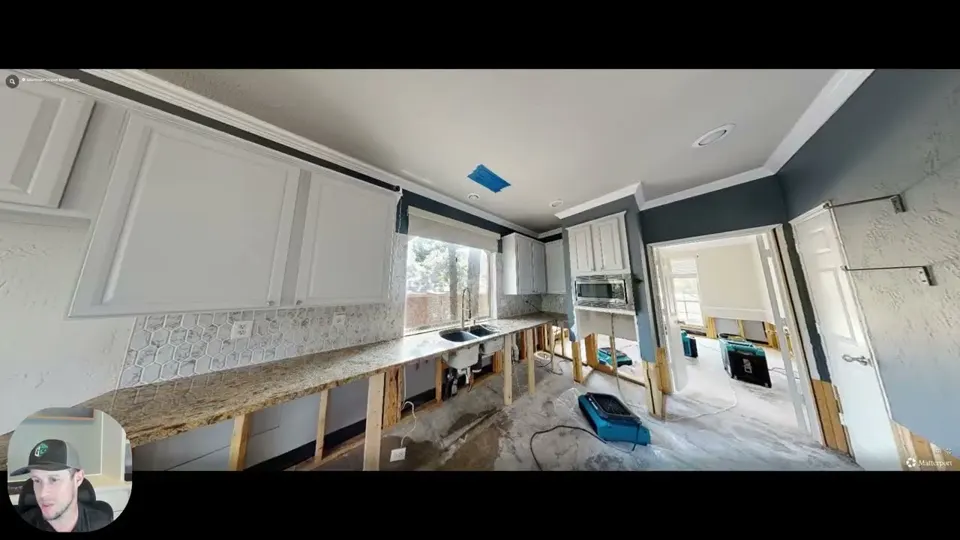
If you've never had a water loss, the first day of mitigation can feel like a stranger version of a home makeover show. People in boots walk in, pull your baseboards, cut a perfectly straight line across your walls and then fill the house with machines that sound like a small airport. Your dog is confused. You're confused. Totally fair. If you want the step-by-step, here's what the first 48 hours after water damage look like.
So let's take the tour. Here's what a CMDR Restoration crew (our mitigation partner, licensed by TDLR, RCO #1801) is doing at your house, and why it's less chaotic than it looks.
Who Shows Up, and What Are the Meters For?
That gadget is a moisture meter, and it's the most important tool in the truck. Water is sneaky. It travels under cabinets, wicks up drywall and slides under flooring into rooms that look totally dry. The crew is measuring where the water actually went, not where the stain stopped.
Some crews also bring a thermal camera. Wet areas often show up as cooler spots. It's basically a superpower for finding water you can't see.
They'll also take a reading in a dry part of your house. That's the "normal" number. Everything wet gets compared to it until it matches.
Why Did They Cut My Walls in a Perfectly Straight Line?
That's a flood cut, and it's on purpose. Under IICRC standards, materials mold can grow on are removed at least 18 inches above the wet line. Most crews cut at 2 feet, because drywall sheets are 4 feet tall. Cut one in half, and the rebuild goes faster and looks cleaner. Matthew calls it super efficient, and he's right.
Is it a little alarming to see the bottom of your walls disappear? Sure. But a straight cut today means a clean patch later, not a wavy mess.
What's With All the Fans?
Those are air movers, and the big boxy machines are dehumidifiers. They're a team:
- Air movers blow across wet surfaces and pull moisture out into the air.
- Dehumidifiers pull that moisture out of the air and send it down a drain line or into a tank.
If you only run fans, you're just shuffling water around the room. Together, they actually dry the structure. Yes, they're loud. Yes, they'll be there for a few days. No, please don't turn them off at night. We know. We're sorry. Earplugs are a great investment.
Why Is There Plastic Sheeting Everywhere?
That's containment. Sometimes the crew creates a smaller drying zone so the equipment works more efficiently. On contaminated water or mold-related jobs, containment also helps keep particles from traveling to the rest of the house. If it looks like a science lab, that's kind of the point.
Why Do They Keep Coming Back?
Monitoring. The crew returns to the same marked spots and takes readings each visit. If numbers are dropping, great. If a wall is being stubborn, they move equipment or open things up a little more. They're logging all of it, which matters later for your records and for the rebuild. You can read more in how structural drying works.
What Are They Doing With My Stuff?
Moving it, blocking it up or packing it out. Furniture legs get foam blocks or foil so they don't wick water or stain the carpet. Electronics and keepsakes get moved somewhere dry. Everything damaged gets photographed before it goes anywhere.
When Do I Get My House Back?
When the readings say dry. On larger jobs with a written protocol from an indoor environmental professional, there's one more step: clearance testing. When it passes, the drying equipment leaves, and G3 starts the rebuild with all the photos and moisture logs in hand. That's the "one team from wet to finished" part we talk about so much. See our water damage page for the full picture.
What Can I Do to Help?
- Keep doors and windows closed unless the crew says otherwise
- Leave equipment where it is, even if it's in the hallway
- Keep pets and kids away from cords and open walls
- Write down questions for the next visit
- Be patient with the noise. It's the sound of your house getting better
Have a leak? Call (945) 300-9018. We'll bring the loud fans.
Frequently Asked Questions
Can I sleep in the house during drying?
Often yes, depending on the damage and the water category. The crew will tell you if a room isn't safe.
Why do they need to remove baseboards?
To open the bottom of the wall for drying and to see how far water traveled.
Will my house smell weird?
Wet materials can smell musty. That should improve as things dry.
How do I know they're done?
Readings match the dry baseline, and on larger jobs, clearance testing passes.
Keep learning: see our CMDR Restoration & Mitigation page, read Burst Pipe Water Damage: What to Do First in North Texas, or read what homeowners say in our customer reviews.
CMDR Restoration · Know Your Next Step
Tell Us What's Happening.
We'll help you understand how G3 can help. Call (945) 300-9018 or use the button below.
GET HELP WITH WATER DAMAGE