
 WatchUnderstanding Water Loss Claims: A Homeowner's Case Study
Y'all, this is one of the questions we hear most, usually from somebody standing in a wet kitchen at the worst possible moment. "Do I need mitigation or restoration?" The honest answer is that most water losses need both, in that order, and the order matters more than people think.
Here's the plain-spoken version. Mitigation stops the damage from getting worse. Restoration puts your home back the way it was. One is triage. The other is surgery and recovery. CMDR Restoration, our mitigation partner (licensed by TDLR, RCO #1801), handles the first part. G3 Roofing and Construction handles the rebuild. You can read more about how we approach both on our water damage page.
What Is Water Mitigation, Exactly?
Mitigation is everything that happens to stop water from doing more harm. That usually includes:
- Finding and stopping the source, or making sure a plumber has
- Extracting standing water from floors and carpet
- Removing materials that can't be dried or that mold can grow on
- Setting up air movers and dehumidifiers
- Taking moisture readings and logging them until the structure is dry
- Cleaning and treating affected areas so the space is ready for rebuild
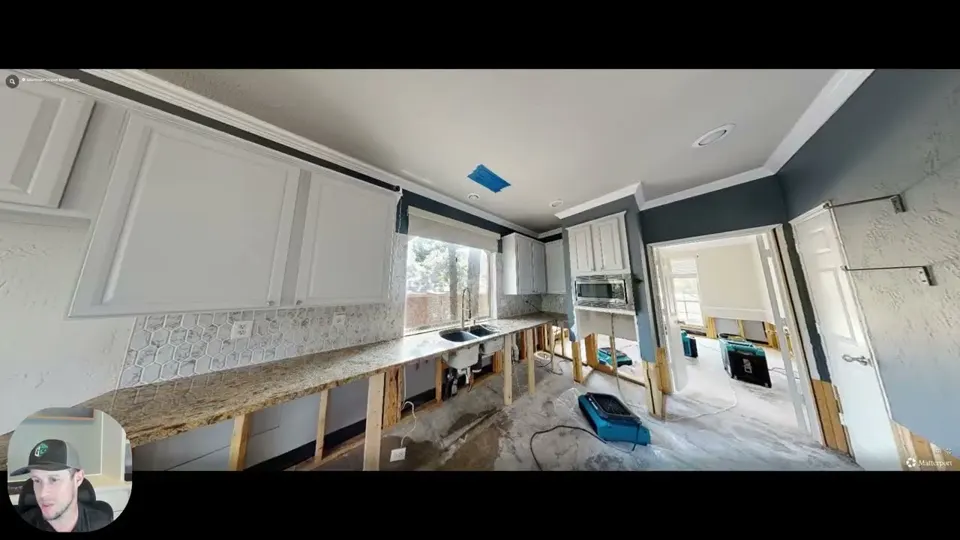
The goal isn't to make your house pretty. The goal is to get it dry, clean and stable. A mitigated room often looks worse than it did the day of the leak, with bare studs, cut drywall and equipment humming everywhere. That's normal. That's progress.
What Is Water Restoration?
Restoration is the rebuild. Once the structure is dry and cleared, a contractor puts back what was removed: drywall, insulation, baseboards, cabinets, flooring, paint and trim. Sometimes it's a few feet of wall. Sometimes it's a whole first floor.
This is where G3 comes in. We're a licensed general contractor, and we treat a water rebuild like any other construction project: a written scope, a schedule and one point of contact. And because we do remodels too, a lot of homeowners use the rebuild as the moment to finally change the things they never liked.
Why Does the Order Matter So Much?
Because you can't rebuild on top of a problem. If wet materials are left in the wall, or the cuts weren't made high enough, mold has everything it needs to grow: moisture, warmth and food. Paper-faced drywall, insulation backing and wood studs are all food.
Matthew has walked into homes where the first mitigation crew pulled out a couple of square feet of drywall and called it good. The homeowner started putting their house back together, and then the musty smell showed up. At that point you're paying to tear out new work to fix old work. Doing mitigation right the first time is the cheapest thing you'll ever do on a water loss.
What Standards Should a Mitigation Company Follow?
The industry follows standards from the IICRC, the Institute of Inspection, Cleaning and Restoration Certification. One example Matthew talks about a lot: flood cuts. The standard calls for removing material that mold can grow on at least 18 inches above where moisture was found. Most crews simply cut at 2 feet, because a sheet of drywall is 4 feet tall and cutting it in half makes the rebuild efficient.
On bigger losses, we like having a protocol written by a licensed indoor environmental professional. That's an unbiased third party. They're not the carrier, who has a reason to save money, and they're not the contractor, who could have a reason to tear out more. They lay out what needs to be removed and cleaned. Then, at the end, they test for moisture and contaminants, and if everything passes they issue clearance.
Can One Company Do Both?
Under the G3 Knows family, CMDR does the mitigation and G3 does the rebuild. They're separately licensed companies that work hand in hand. That means the people drying your house are already talking to the people who'll rebuild it. Photos, moisture logs and the list of what was removed get handed straight to the rebuild team, so nothing gets lost between "dry" and "done." Here's why we handle mitigation and rebuild with one team.
It also means you aren't stuck calling two strangers and playing telephone between them.
What Should I Do If I'm Not Sure Which One I Need?
Start with the source. If water is still moving, shut it off at the main and call a plumber if you need one. Then call us. We'll look at what got wet, how far it traveled and what materials are involved, and we'll tell you straight what we see. We don't hard sell. We show you the photos and let you decide.
If you're dealing with it right now, call (945) 300-9018. And if you want to understand what comes next, read our guide on how structural drying works.
Be Grateful. Be Generous. Be Good.
Frequently Asked Questions
Is mitigation the same as remediation?
Not quite. Mitigation deals with water and drying. Mold remediation deals with mold that's already growing. Some losses need both.
Can I skip mitigation if the water dried on its own?
Surfaces can feel dry while walls, subfloors and insulation are still wet. Moisture readings tell the real story.
Who decides what gets removed?
On larger losses, a licensed indoor environmental professional's protocol guides it. On smaller ones, moisture readings and IICRC standards do.
Does G3 do the rebuild after CMDR dries the house?
Yes. That's the whole point of the partnership: one team from wet to finished.
Keep learning: see our CMDR Restoration & Mitigation page, read Wet Drywall: Can It Be Dried or Does It Need Replacing?, or read what homeowners say in our customer reviews.
CMDR Restoration · Know Your Next Step
Tell Us What's Happening.
We'll help you understand how G3 can help. Call (945) 300-9018 or use the button below.
GET HELP WITH WATER DAMAGE