
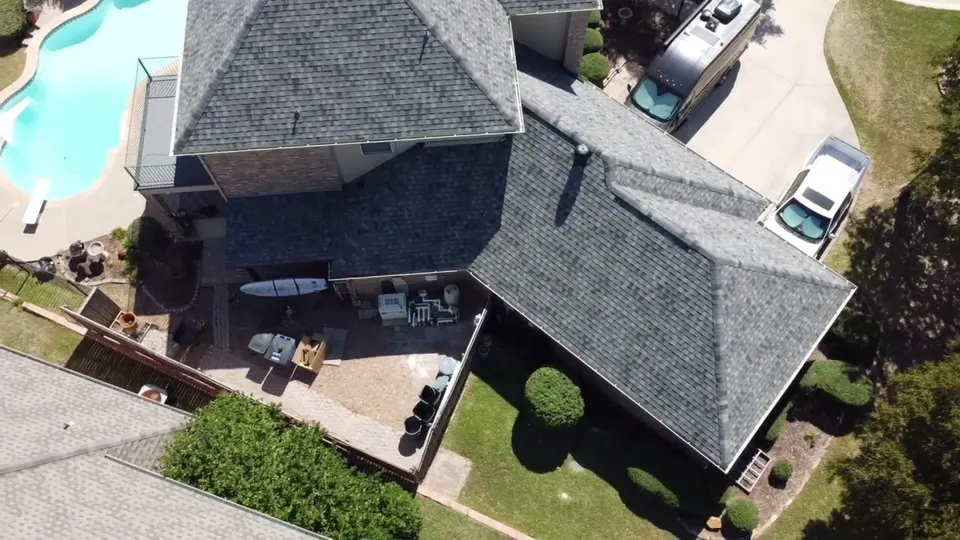
 WatchCertainTeed Landmark Georgetown Gray in Highland Village, TX
The first time most homeowners see a roofing estimate, they squint at it like it's a tax form. Squares, drip edge, starter, IWS, hip and ridge, O&P. It's a lot. Here's a plain-English guide to reading a roofing estimate, whether it's from us or from someone else.
This is about understanding a contractor's estimate. It's not advice about your insurance policy. For questions about coverage, talk to your carrier or agent.
What Is a "Square"?
A roofing square is 100 square feet of roof area. A roof measured at 30 squares is about 3,000 square feet of roof surface. That's not the same as your home's living space. Pitch, overhangs and complicated rooflines add area. Most estimates also include a waste factor, because shingles get cut to fit hips, valleys and edges.
What Are the Common Line Items?
Here's what you'll often see, and what each means:
- Tear-off / remove roofing: Removing the old shingles and underlayment.
- Shingles: The product, by manufacturer and line, measured in squares.
- Starter strip: A row of shingles at the eaves and rakes that helps seal the first course.
- Underlayment / felt: The layer between decking and shingles.
- Ice and water shield: Waterproof membrane for valleys, low slopes and penetrations.
- Drip edge: Metal at the roof edges that guides water into the gutters.
- Hip and ridge caps: Shingles that cover the peaks and hips, measured in linear feet.
- Valley metal: Metal that protects the valleys.
- Flashing: Step flashing, counter flashing, chimney flashing and pipe jacks.
- Vents: Box vents, ridge vents, turbines, exhaust caps.
- Decking replacement: Often listed per sheet, because nobody knows how much is bad until the old roof is off.
- Permits and disposal: Dumpsters, haul-off and local permits.
What Is Xactimate, and Why Do I See It?
Many insurance carriers and contractors use estimating software called Xactimate. If you've had a storm claim, the carrier's estimate likely came from it. Contractors often write estimates in the same format so line items can be compared. Matthew notes that Xactimate doesn't always price everything well, so for items outside its scope, like some HVAC repairs, we get separate quotes and document them.
What Should I Look for When Comparing Estimates?
- Is it the same product? Same manufacturer, same line, same impact rating.
- Are flashings and vents replaced or reused? We replace all of them.
- Is ice and water included where it should be?
- Is valley metal included?
- What ridge caps are specified?
- How is decking handled? A per-sheet price is normal.
- What about gutters, screens and other damage? Some estimates only cover the roof and leave the rest.
- Who pulls the permit?
- What's the workmanship warranty, in writing?
The lowest number isn't always the best deal if it leaves out the parts that keep water out.
What Red Flags Should I Watch For?
- A one-line estimate that just says "new roof"
- No product name or color
- Pressure to sign the same day
- Requests for large payments before materials arrive
- Promises about what your insurance will pay
- No license information or proof of insurance
Our guide on how to spot a storm chaser roofer goes deeper.
How Does G3 Write Estimates?
Clearly. We list the product, the color, the system components and the scope of work, including everything we found that was damaged, not just the shingles. We walk you through it line by line and answer every question. As your contractor, we document the damage and the work. We don't negotiate or adjust claims.
Learn more on our roofing and storm damage page, or call (945) 300-9018. Our homeowner reviews show how we walk folks through an estimate, line by line.
Frequently Asked Questions
Why does the estimate say more squares than my house size?
Roof area includes pitch, overhangs and waste, so it's larger than floor space.
What does O&P mean?
Overhead and profit, a common estimating term for a general contractor's costs on multi-trade jobs.
Why is decking priced per sheet?
Because damaged decking can't be counted until the old roof is off.
Should I always pick the lowest bid?
Compare scope first. A lower price may leave out important parts.
Keep learning: see our Roofing & Storm Damage page, read How to Tell If Your Roof Has Hail Damage, or read what homeowners say in our customer reviews.
Know Your Next Step
Tell Us What's Happening.
We'll help you understand how G3 can help. Call (945) 300-9018 or use the button below.
SCHEDULE AN INSPECTION