
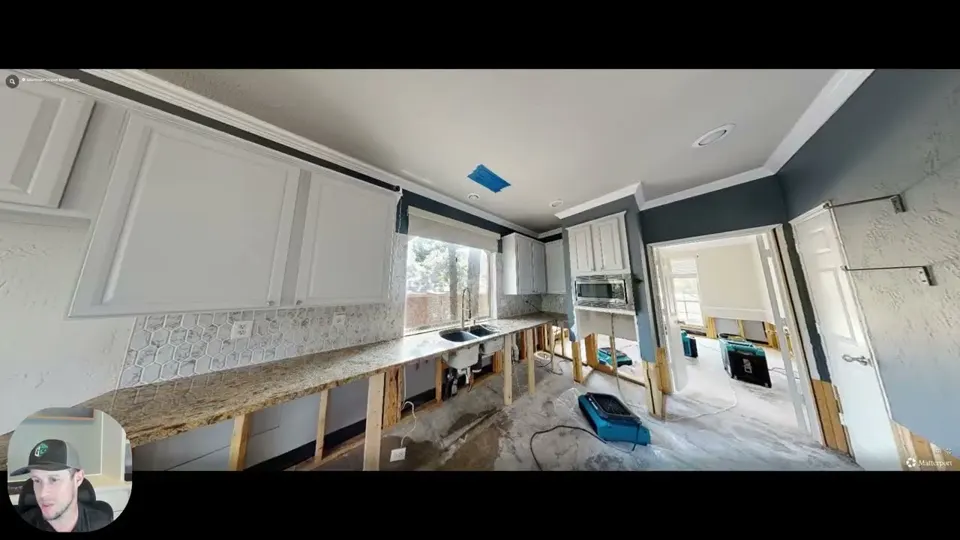
 WatchUnderstanding Water Loss Claims: A Homeowner's Case Study
Matthew has a line he uses a lot: we document and rely on the facts. After a water loss, good documentation is the difference between a clear story and a confusing one. It helps you, it helps your rebuild contractor and it helps anyone else who needs to understand what happened to your home.
This guide is about documenting the condition of your home and the work done on it. It's not advice about insurance or your policy. For those questions, talk with your carrier or agent.
What Should I Document Right Away?
As soon as the source is stopped and everyone is safe:
- The source. The broken pipe, failed supply line, overflowing fixture or water heater. Keep the failed part if you can.
- Each affected room. Wide shots first, then close-ups of floors, walls, ceilings and baseboards.
- Standing water. How deep, and where it reached.
- Damaged belongings. Brand, model and condition when possible.
- Time and date. Write down when you discovered the water and when you shut it off.
- Video walk-through. Narrate what you see. It's easy and very helpful.
What Does Good Mitigation Documentation Include?
A professional mitigation company should give you records. Ask for:
- Moisture readings at marked locations, from the first visit until dry
- A moisture map showing where water traveled
- Photos before, during and after removal
- A list of materials removed, like drywall, insulation, carpet, pad and baseboards, with locations and amounts
- Equipment logs showing what was placed and for how long
- The water category and the reasoning
What Is a Protocol, and Why Does It Matter?
On larger or more complex losses, we like to work from a written protocol by a licensed indoor environmental professional. In one of our case study videos, Matthew walks through one that was 42 pages long. It mapped exactly what needed to be removed, cleaned and tested.
The IEP is an unbiased third party, not the carrier and not the contractor. After mitigation, they test for moisture and contaminants. If everything passes, they issue clearance. That clearance letter is one of the most important documents in your file. It shows the work was done to standard.
What Happens When Documentation Is Thin?
Matthew's case study tells the story. A first mitigation, done by another crew, removed very little drywall, left carpet down and made no flood cuts. The estimate for restoring the home was based on that limited work. Once the house was mitigated properly to a protocol and everything was documented, the scope of work needed to restore the home was much larger. The lesson: when materials are removed and documented correctly, the record reflects what the home actually needs.
How Should I Organize My Records?
Keep one folder, paper or digital:
- Photos and videos, labeled by room
- Mitigation records: moisture logs, maps, removed materials list, equipment logs
- Protocol and clearance letter, if applicable
- Plumber invoices and the failed part
- Receipts for emergency costs, like hotel stays or supplies
- A contents list of damaged belongings
- All correspondence, with dates
What About the Rebuild?
Your rebuild contractor needs the mitigation records to write an accurate scope. With CMDR Restoration (our mitigation partner, licensed by TDLR, RCO #1801) and G3 working together, those records go straight to the rebuild team. Read mitigation and rebuild with one team for more.
Who Does What?
We're your contractor. We inspect, document and rebuild. We don't negotiate or adjust claims, and we don't interpret policies. Learn more on our water damage page or call (945) 300-9018.
Frequently Asked Questions
Should I keep the broken part?
Yes. Bag it, label it and keep it with your records.
Can I get copies of moisture logs?
Ask your mitigation company. A good one will provide them.
Is a clearance letter always needed?
Not on every loss, but on larger or contaminated losses it's valuable.
How do I list damaged contents?
Room by room, with photos, descriptions and approximate age.
Keep learning: see our Water Damage page, read First 24 Hours After Water Damage: A Homeowner Checklist, or read what homeowners say in our customer reviews.
Know Your Next Step
Tell Us What's Happening.
We'll help you understand how G3 can help. Call (945) 300-9018 or use the button below.
GET HELP WITH WATER DAMAGE